
The best small-bathroom ideas aren’t about visual tricks — they’re about reclaiming inches: a wall-hung toilet that frees six inches of floor, a pocket door that returns nine square feet of swing space, a recessed niche that replaces a shower caddy. Small bathrooms reward ruthless practicality more than big ones reward beauty.
A typical small bathroom remodel runs about $6,500 nationally, with real projects spanning $2,000 for a basic refresh to $15,000+ for a full gut — and per-square-foot costs run higher than large baths because every trade still shows up. (USA Cabinet Store) Below are twelve ideas ranked by what they cost and what they actually deliver, each tagged with its budget tier: $ (under $500), $$ ($500–$3,000), $$$ ($3,000+).
Key takeaways
– The highest-impact small-bathroom moves are layout changes: pocket doors, wall-hung fixtures, and recessed storage reclaim real square footage.
– Lighting is the cheapest transformation — layered light makes a small bath feel twice its size for a few hundred dollars.
– Keep the palette tight (two to three finishes max); visual calm reads as spaciousness.
– Storage should go up and in — tall cabinets, recessed niches, over-toilet shelving — never out into the room.
– Small doesn’t mean cheap per square foot: budget $80–$120/sq ft for refreshes, $180–$280 for mid-range, $300–$500+ for premium.
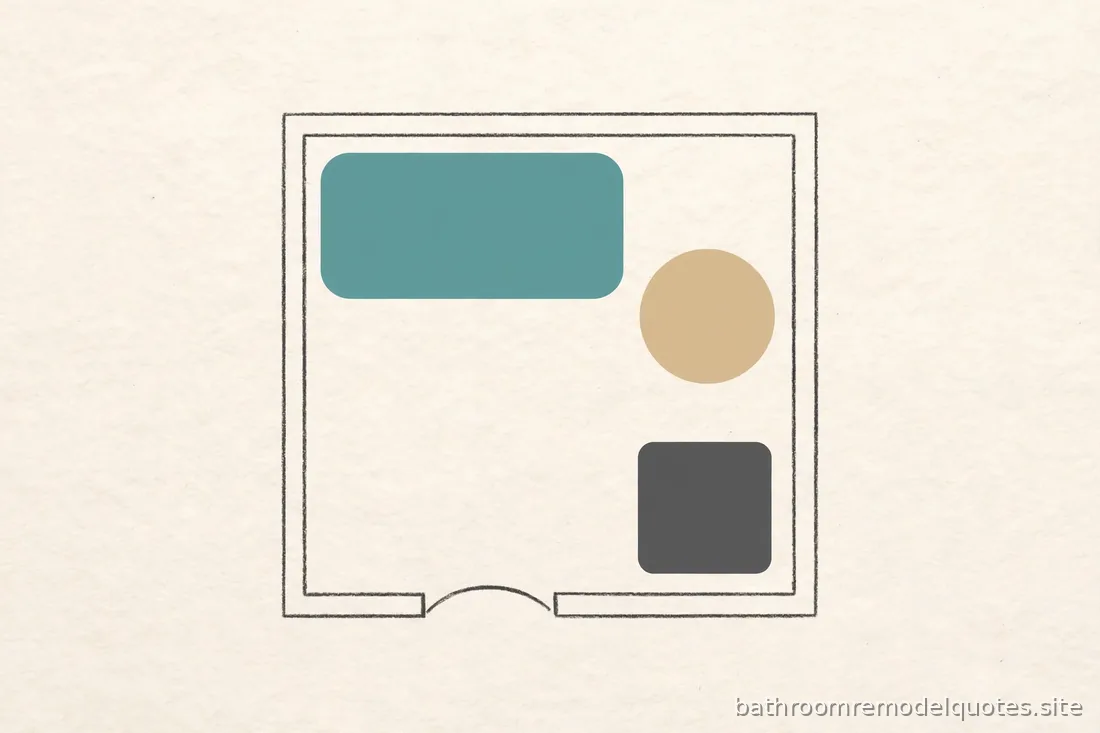
Layout Moves: The Inches That Matter
1. Swap the swing door for a pocket door — $$. A standard 28-inch bathroom door needs about nine square feet of swing clearance — in a 35-square-foot bath, that’s a quarter of the room held hostage by a door. A pocket door returns all of it. Cost: a few hundred for the hardware and framing labor during a remodel, more as a standalone retrofit (opening the wall is the expensive part). If pocket framing isn’t possible, a barn-style slider on the hallway side achieves most of the gain.
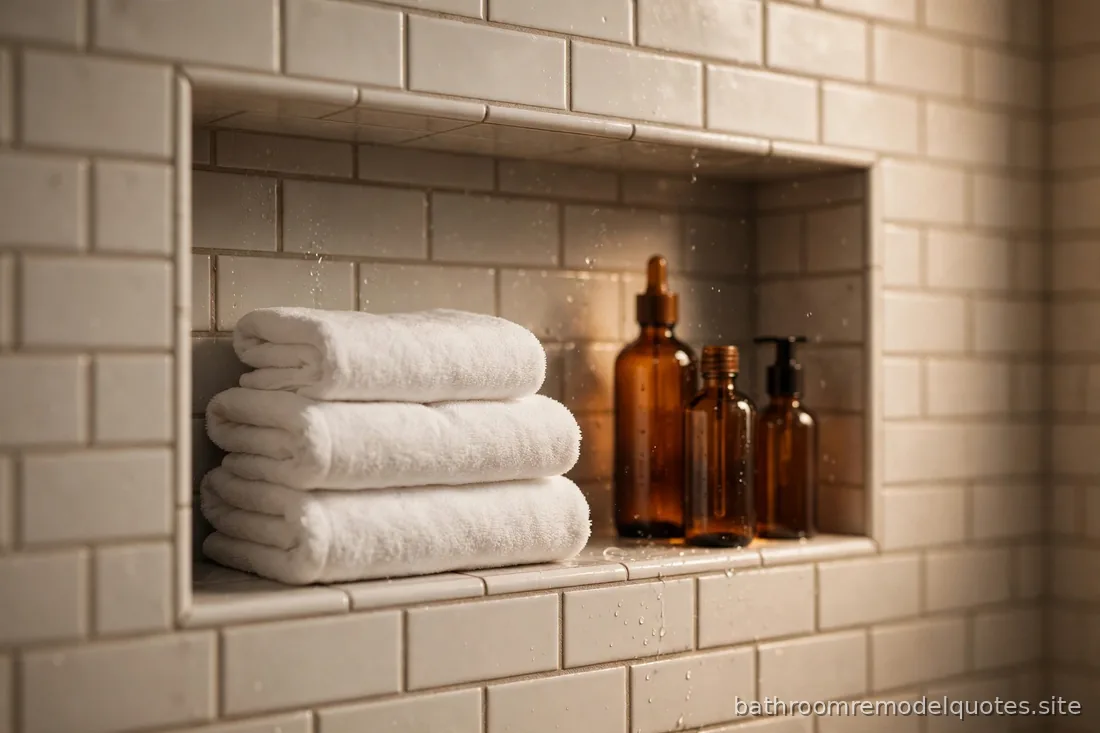
2. Recess instead of protrude — $$. A medicine cabinet recessed between studs, a shower niche carved into the wall, a toilet-paper holder set into the wall — each one returns two to four inches of clearance where it matters most: at hip and elbow height. Niches cost little during a gut (framing + waterproofing + tile) and a lot after one. Plan them before the tile goes up, not after.
3. Rethink the vanity footprint — $ to $$. The classic 21-inch-deep vanity eats a shocking amount of a small bath. An 18-inch-deep vanity, a wall-hung (floating) vanity, or a pedestal sink with a separate storage tower can free 3–6 inches of floor depth — the difference between a comfortable room and a sideways shuffle. Floating vanities have a second trick: visible floor underneath reads as more space (more on the visual side in our make a small bathroom look bigger guide).
4. Consider a wet-room layout — $$$. In very small baths, eliminating the shower curb and enclosure entirely — one waterproofed, sloped floor for the whole room — removes the single bulkiest object in the space. It’s a bigger waterproofing job (and a bigger check), but for sub-40-square-foot baths it’s transformative.
Fixtures That Earn Their Footprint
5. Wall-hung toilet — $$$. The tank hides in the wall; the bowl floats. You gain roughly six inches of visible floor, cleaning becomes a mop swipe, and the room looks intentionally designed rather than cramped. The catch: the in-wall carrier needs a thicker wall and costs more to install than a standard toilet — budget for it as a premium fixture choice, not a casual swap.
6. Corner or compact fixtures — $. A corner sink in a powder room, a compact elongated toilet (same comfort, shorter projection than standard elongated), a narrow trough-style vanity — none of these are glamorous, all of them work. In a 5×7 bath, an inch shaved off three fixtures is three inches of walkway gained.
7. A shower instead of a tub — $$ to $$$. In a small hall bath, replacing the tub with a shower (or a shower-tub combo with a low-profile surround) typically frees visual and physical space. The short version: if it’s not the only tub in the house, the shower usually wins in small baths.
Storage Without Bulk
8. Go tall and shallow — $. A 12-inch-deep tall cabinet holds as much as a 24-inch-deep vanity base while protruding half as far. Over-toilet shelving or a tall linen tower uses dead vertical space. The rule: storage should grow up, not out.
9. Steal space from adjacent rooms — $$. The back of a closet, the hallway wall behind the bathroom — a recessed cabinet steals 3–4 inches from the neighboring room’s depth and nobody notices. During a remodel, framing a niche into a non-load-bearing shared wall is cheap; the storage it yields is permanent.
10. One drawer beats three doors — $$. Deep vanity drawers with organizers store more accessibly than cavernous cabinet doors where everything migrates to the dark back corner. When choosing a vanity for a small bath, prioritize drawer count over door count.
Lighting That Changes Everything
11. Layer the light — $ to $$. Small bathrooms are chronically under-lit: one harsh overhead that casts shadows exactly where you shave or apply makeup. The fix is three layers — overhead (a bright, diffused ceiling light), task (sconces or a light bar at face height beside the mirror, not just above it), and accent if you’re feeling fancy (LED strip under a floating vanity). A couple hundred dollars in fixtures and an electrician’s hour or two, and the room feels twice its size. Light is the cheapest square footage you’ll ever buy.
Surfaces and Color Discipline
12. Two to three finishes, max — $ (discipline is free). Every new material in a small bathroom is a visual boundary, and boundaries chop space into smaller-feeling pieces. Pick a floor tile, a wall treatment, and one accent — then repeat them. Large-format floor tile with minimal grout lines, one wall color carried everywhere, matching metals. Restraint reads as spaciousness; variety reads as clutter. Our bathroom flooring guide covers small-bath-friendly materials, and the visual-expansion playbook continues in how to make a small bathroom look bigger.
Ideas by Budget Tier
The $2,000 refresh (weekend warrior): paint in a light, warm white; new mirror (go bigger — it doubles light); new light bar at face height; new hardware and faucet; re-caulk everything; a tall, narrow storage tower from a big-box store. No plumbing moves, no tile work. This is the highest impact-per-dollar project in remodeling.
The $7,000 smart remodel (hired out): everything above, plus: LVP or tile flooring, a new 30-inch vanity with drawers, a shower niche cut in during a surround replacement, a pocket door if the wall allows, and a properly vented exhaust fan. This lands near the national ~$6,500 typical small-bath figure. (USA Cabinet Store)
The $15,000+ full gut: layout reconfigured (toilet relocated for a better flow — the expensive move that earns it), wall-hung toilet, floating vanity, curbless shower, recessed everything, layered lighting on dimmers. Every inch intentional. Per-square-foot costs at this tier run $300–$500+ because the labor intensity per square foot is the highest in the house.
Small-Bathroom Mistakes to Avoid
- The giant vanity. A 48-inch double vanity in a 5×7 bath leaves no room to move and screams “wrong.” Size fixtures to the room, not the fantasy.
- Dark, busy tile everywhere. A dramatic patterned tile is gorgeous in a photo and exhausting in a 35-square-foot room you use half-asleep at 6 AM. If you love pattern, confine it to one wall or the shower niche.
- Skipping the exhaust fan. Small baths steam up faster and dry slower — exactly the conditions that grow mold behind that beautiful new paint. Ventilation is not optional at this scale; it’s structural.
- Glass shower doors that eat the room. Frameless glass is lovely but needs swing or slide clearance you may not have. In tight baths, a well-chosen shower curtain on a curved rod often works better and costs 90% less.
- No landing space. Every sink needs somewhere to put a toothbrush — even a 6-inch shelf. A beautiful pedestal sink with zero counter space is a daily frustration machine. Plan the landing zone before you fall for the fixture.
For the dollars-and-cents companion to these ideas, our small bathroom remodel cost guide breaks down what each tier buys.
Frequently Asked Questions
What’s the best layout for a small bathroom?
Keep the plumbing where it is unless the layout is genuinely dysfunctional — moving a toilet or drain in a small bath costs nearly as much as in a large one while buying fewer inches. Within the existing footprint: pocket door, floating vanity, recessed storage, and the largest mirror the wall allows.
How much does it cost to remodel a 5×7 bathroom?
A 5×7 bath (35 sq ft) typically runs $2,800–$4,500 for a cosmetic refresh, $5,500–$9,000 mid-range, and $9,000–$13,000+ for a full gut, per 2026 national pricing data. The national typical small-bath remodel is about $6,500. (USA Cabinet Store)
Can you put a full bathroom in a small space?
Yes — a 5×7 footprint fits a toilet, sink, and tub-shower combo comfortably; it’s the most common full-bath size in American homes. Below about 35 square feet, consider a three-quarter bath (shower instead of tub) to keep clearances comfortable.
What’s the cheapest way to make a small bathroom look better?
Paint, a bigger mirror, better lighting, and new hardware — under $500 total and a weekend of work. These four changes alter light, reflection, and first impressions more than any single expensive fixture.
Should I remove the tub in a small bathroom?
If it’s not the only tub in the house, usually yes — a shower frees meaningful space in a small footprint. If it is the only tub and you might sell to a family, keep it (or keep a combo).
This is general information, not professional advice — get itemized bids for your project.