
Porcelain tile costs $10–$35 per square foot installed and is the most waterproof, longest-lasting bathroom floor. Luxury vinyl plank (LVP) costs $5–$17 installed, handles water well, and is warmer underfoot — but it’s shorter-lived and buyers rate it below tile. Hardwood, laminate, and carpet are mistakes in a bathroom.
Those numbers come from a 2026 USA Today expert roundup: tile materials run $5–$20 per square foot with $5–$15 installation, while vinyl plank materials run $2–$10 with $3–$7 installation — tile costs at least twice as much per square foot as vinyl once labor is in. (USA Today)
Key takeaways
– Porcelain tile ($10–$35/sq ft installed) is the most waterproof and longest-lasting bathroom floor; it’s also the one buyers value most at resale.
– Luxury vinyl plank ($5–$17/sq ft installed) is a legitimate budget choice — waterproof and warmer, but shorter-lived with lower resale perception.
– Grout lines are the water weak point: minimize them and skip glossy finishes near wet areas.
– Hardwood, laminate, and carpet have no business in a bathroom, period.
– Flooring is a small line item in a remodel — don’t let it drive the whole budget.
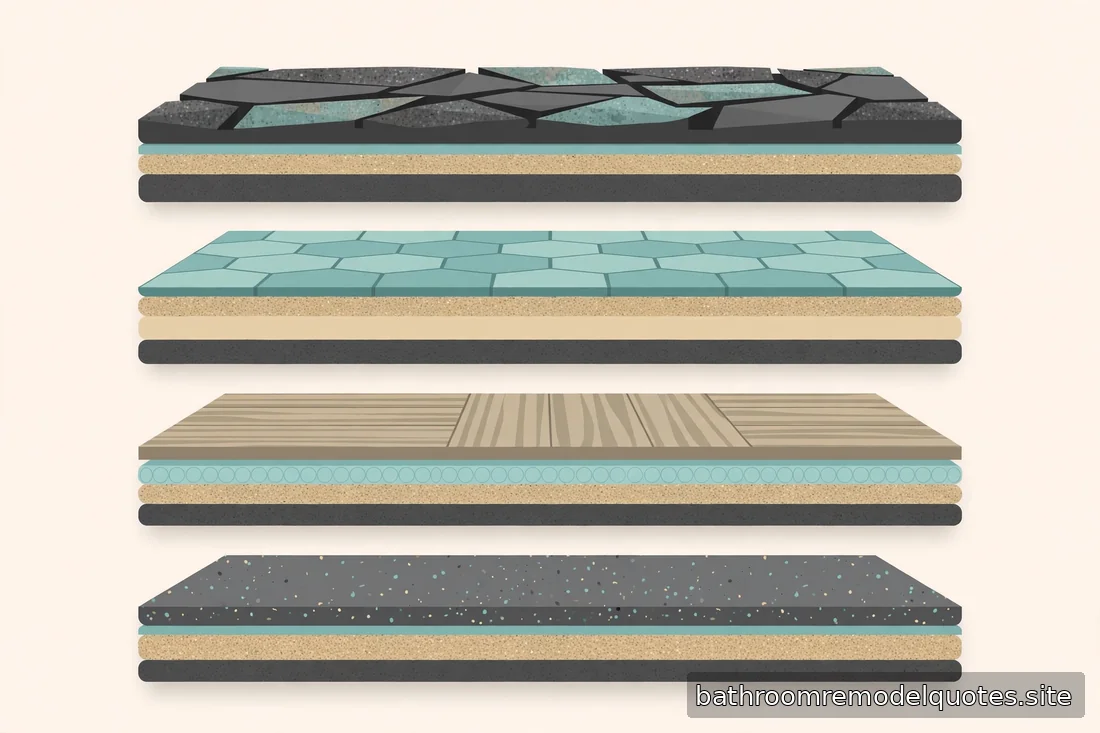
The Three Jobs Every Bathroom Floor Must Do
Experts boil bathroom flooring down to three requirements:
- Water resistance. “In a bathroom, every joint, every corner, every seam needs to be ready for water,” said Joyce Van Waeleghem, VP of design at Mohawk Flooring. “It is a wet environment by definition, and if your flooring is not built to handle that, you are going to have problems no matter how beautiful it is.” (USA Today)
- Easy to clean and stain-resistant. A floor that can’t handle constant wet cleaning is a slow-motion failure.
- Non-slippery. “The biggest no-no is a high-gloss tile near a shower or tub,” explained designer Jenny Marrs. “It looks beautiful in photos, but the second it gets wet it turns into a skating rink.” (USA Today)
Perspective: flooring is one of the smaller line items in a full remodel. This Old House’s July 2026 per-component national averages put flooring at about $1,114 — less than the tiling line ($1,326), and a fraction of the shower ($8,044) or plumbing ($5,545) lines. (As reported on bossdesigncenter.com, citing This Old House.) So don’t let a $4-per-square-foot material upgrade torpedo a budget — on a 40-square-foot bath, that’s $160.
Tile: The Gold Standard (and Its Real Price)
Tile is the default bathroom floor because, installed properly, porcelain is the most waterproof option available.
The cost. Per 2026 expert pricing: ceramic tile materials run $2–$3 per square foot at the bargain end (basic ceramic from a home-improvement store) up to $30+ for marble or natural stone from a specialty supplier; most homeowners land in the $5–$20 per square foot range for materials. Installation adds $5–$15 per square foot, for a total installed cost of $10–$35 per square foot. Demo and removal of the old floor is extra. (USA Today)
Tile labor is where the spread lives. This Old House puts professional tile installation labor broadly at $3–$15 per square foot — the spread is about difficulty: large-format porcelain needs flatter substrate and more prep; mosaic needs more cuts and grout; patterned layouts add time and waste. Material and labor invoices move together. (As reported on bossdesigncenter.com, citing This Old House.)
Which tile:
- Porcelain is the gold standard. “Porcelain tile is my absolute gold standard,” said kitchen and bath director Shannon Kadwell — “incredible durability, near-zero water absorption and endless style options.” (USA Today)
- Natural stone (marble, travertine, slate) is beautiful and often less slick than polished tile — but it needs sealing and maintenance, and material prices run high.
- Terra cotta brings warmth but needs regular sealing, and its red-brown palette doesn’t fit every home.
The honest water-risk talk. The tile is nearly bulletproof, but the grout lines are the weak point — grout is porous, so minimize joints with larger tiles and seal natural stone on schedule. And your subfloor matters as much as the tile: tile over a flexing subfloor eventually cracks, so fix a spongy floor first or choose a forgiving material.
When tile is the right call: a primary home you’re keeping, any home where resale matters (buyers read tile as higher-end), or when you want the design range — porcelain, ceramic, glass, and mosaics give you enormous creative room in a small space.
Luxury Vinyl: The Honest Budget Pick
Luxury vinyl — plank (LVP) or tile (LVT) — has a legitimate case in bathrooms: waterproof, affordable, easier to install, and durable. This is not the peel-and-stick vinyl of the 1990s.
The cost. Materials run $2–$10 per square foot, with the $4–$7 range being the best mix of quality and value. Installation adds $3–$7 per square foot, for a total of $5–$17 per square foot installed — roughly half the cost of tile on average, sometimes less. (USA Today)
Three real advantages:
- Forgiveness. If your subfloor flexes and you aren’t replacing it, vinyl tolerates it where tile cracks. It’s also warmer and softer under bare feet.
- Speed and simplicity. Less labor-intensive installation means a shorter project and a smaller labor bill.
- Rentals and flips. Durable, cheap, and easy to replace — the rational pick where budget and turnaround are the priorities.
Vinyl is a shorter-lived floor than tile — think a decade-plus, not multiple decades — and buyers rate it below tile. Buy a thicker wear layer (20 mil or better) and skip the cheapest click-lock over a wavy subfloor.
The water-risk fine print. “Waterproof” describes the plank, not the installation. A floating click-lock floor still has seams, and standing water that sits in those seams long enough will find its way underneath. The practical rule: squeegee up standing water, caulk the perimeter properly (especially at the tub and toilet), and don’t treat “waterproof” as “flood-proof.”
Sheet Vinyl, Stone, and the Rest
Sheet vinyl is the quiet workhorse: one continuous sheet, almost no seams, genuinely water-resistant, and the cheapest legitimate option — a real waterproofing advantage for a kids’ bath or tight budget.
Warning: laminate is not recommended for bathrooms — moisture gets trapped, swelling and rot follow. Some brands market “water-resistant” laminate, but in a room where every seam meets water daily, that’s a gamble I’d never take with my own money. (USA Today)
Heated Floors: Comfort or Money Pit?
A heated floor adds a line item — the mat or cable, a thermostat, and an electrician’s time on a dedicated circuit. It’s a comfort upgrade, not a value upgrade — lovely on cold mornings, but it won’t move your appraised value.
It makes sense for cold climates, tile floors (tile conducts heat well; check the manufacturer’s temperature limits before putting LVP over radiant heat), and bathrooms you use barefoot every morning. Skip it for a guest bath used twice a year or a tight budget — spend that money on shower waterproofing or the exhaust fan first.
Get it quoted as its own line item so you can see the true cost. Note that adding a circuit is electrical work that typically falls under the permit umbrella — see our bathroom remodel permit guide.
Flooring to Avoid in Bathrooms Entirely
These fail in bathrooms — and the failure takes the subfloor with it:
- Solid hardwood. “Even a small leak can quickly lead to warped wood, mold and smell issues that will force you to replace the whole floor and subfloor,” warns one tiny-home builder quoted in the 2026 USA Today guide. In a bathroom, “a small leak” is a matter of when, not if. (USA Today)
- Engineered hardwood. More water-resistant than solid wood, still susceptible to moisture and swelling — especially in a poorly ventilated bath.
- Carpet. Holds moisture and grows mold. As one designer put it: “Why on earth would anyone think that is a good idea!?”
- Cork. Water-resistant only when perfectly sealed, and keeping it sealed is a maintenance treadmill.
- Standard laminate. Swells, molds, rots. Full stop.
If a contractor suggests any of these for a bathroom, that’s useful information about the contractor.
Two Real-World Scenarios
Denise in Columbus, Ohio — the forever-home primary bath. Denise is remodeling the 45-square-foot main bathroom she’ll use for the next 15 years: 12×24 porcelain tile at $8/sq ft materials ($360) with $9/sq ft installation ($405), plus $150 for demo and subfloor patching — about $915 all-in. A fraction of her $14,000 project, and what a future buyer expects.
Marcus in Phoenix, Arizona — the rental refresh. Marcus owns a duplex and needs the hall bath tenant-proofed fast between leases: 20-mil LVP at $5/sq ft materials ($200 for 40 sq ft) with $4/sq ft installation ($160) — about $360 plus a day of work. Waterproof enough for tenants, and cheap to replace. The real money goes to the exhaust fan and a proper tub re-caulk — the things that prevent damage claims.
The pattern: the floor is a supporting actor. The stars are the shower, the plumbing, and the labor — which is why getting the whole-project budget right matters more than agonizing over $3 per square foot. (Our bathroom tile cost breakdown covers shower walls.)
Questions to Ask Before You Choose
Take this list to your contractor or flooring store:
- What’s the installed price per square foot, including demo, subfloor prep, and transitions? Material-only quotes are meaningless. Get the all-in number.
- What does my subfloor look like, and does it need work before this floor goes down? Flex, rot, or unevenness must be addressed first — especially under tile.
- For tile: what’s the grout plan? Larger tiles and epoxy grout mean fewer maintenance headaches. Ask what grout they recommend and why.
- For vinyl: what’s the wear layer thickness, and is it rated for bathrooms? Don’t accept “it’s waterproof” — ask for the spec.
- Who handles the toilet reset and the baseboards? A flooring quote that doesn’t mention pulling and resetting the toilet isn’t a complete quote.
- What happens if water gets underneath? The answer reveals whether the installer has actually thought about failure modes.
Frequently Asked Questions
What is the cheapest bathroom flooring that still holds up?
Sheet vinyl and basic LVP — LVP runs $5–$17 per square foot installed. Both handle bathroom moisture well when installed correctly. Don’t chase cheap with laminate or carpet; the “savings” evaporate the first time water gets underneath.
Is luxury vinyl plank really waterproof enough for a bathroom?
The planks themselves are waterproof, and properly installed LVP is a genuinely good bathroom floor — easier to maintain than tile, with no grout lines to scrub. The caveat is the seams: standing water left in click-lock joints migrates underneath. Squeegee up puddles and caulk the perimeter.
Does bathroom flooring affect home value?
Tile best supports home value — buyers read it as the higher-end, permanent choice. Vinyl won’t hurt a modest home, but an upscale primary bath calls for tile. At ~$1,100 nationally (This Old House 2026 averages), the math favors doing it right once.
Can I install bathroom flooring myself?
LVP click-lock is DIY-friendly — but subfloor prep, the toilet reset, and perimeter caulking still matter, and mistakes there cause the failures. Tile is a skilled trade: bad tile work fails slowly and expensively. Angi’s guidance is to DIY cosmetic work like painting and leave skilled installations to pros. (Angi)
How long does bathroom tile last versus vinyl?
Properly installed porcelain tile routinely lasts 20+ years — often the life of the bathroom. LVP is generally a 10–15 year floor. That lifespan gap is why tile costs roughly twice as much installed: you buy the floor once instead of twice.
This is general information, not professional advice — get itemized bids for your project.