
Most bathroom remodels don’t go over budget from one catastrophe — they go over from five or six small, predictable decisions nobody flagged in advance. The difference between landing on budget and landing 40% over is rarely luck. It’s planning.
Here are the nine mistakes I see most often, what each typically costs, and how to avoid it — starting with the right questions before demolition (see our quote-comparison guide).
Key takeaways
– Hold back 10–20% of your budget as contingency — Angi’s own guidance, and the single highest-leverage planning move you can make.
– Moving a fixture even three feet can cost $500–$1,000; a full layout change runs about $5,000 before finishes.
– Allowances that look generous on paper are where bids quietly grow — convert them to fixed selections before you sign.
– Every change order should be priced and signed in writing before the work happens. Verbal “yeah, we can do that” is how budgets die.
– The cheapest bid is usually missing something. Find out what before you sign, not after.

1. No Contingency Fund
This is mistake number one because it amplifies every other mistake on this list. Bathrooms hide things — rotted subfloor, corroded drains, outdated wiring, a badly installed shower pan — and you can’t see any of it until the tile comes off.
Angi’s budgeting guidance is explicit: set aside 10–20% of your budget for unforeseen expenses so surprises don’t derail the project. (Angi) On a $12,000 remodel, that’s $1,200–$2,400 sitting untouched until something genuinely unexpected appears.
The failure mode is always the same: the homeowner budgets to the last dollar, the contractor finds a rotted subfloor on day three, and a $900 repair lands with no money allocated. A contingency fund doesn’t prevent surprises — it prevents them from becoming crises.
2. Moving Plumbing Without Counting the True Cost
Relocating a fixture is the single decision most likely to change your budget — and it’s usually made during design, when it feels like a drawing choice rather than a cost. The published benchmarks give you the scale: moving a fixture three feet or more runs $500–$1,000 (Angi), while a floor-plan change requiring plumbing and electrical rework lands around $5,000 (NerdWallet). Those are national planning figures, not quotes — but they tell you the order of magnitude. (As reported on bossdesigncenter.com.)
The cost climbs because moving a fixture means opening the floor to reach the drain — over a crawlspace the plumber works from below; on a slab, concrete gets cut and repoured. Then the vent follows the drain, supply lines get rerun, framing gets patched, and waterproofing and tile go back over it all.
The rule: keep fixtures where they are unless the new layout is worth roughly $5,000 to you. Make it a conscious purchase, not a casual sketch.
3. Falling for Allowance Traps
An “allowance” is a placeholder number in a bid for a product you haven’t selected yet — say, $800 for “tile.” Allowances aren’t dishonest by themselves; they’re necessary when you haven’t picked finishes. They become a trap when set unrealistically low to make the bid total look attractive.
Contractor A bids $12,000 with a $600 tile allowance; Contractor B bids $13,500 with tile specified at $1,400. You pick A — then discover the $600 allowance buys builder-grade ceramic, and the tile you want costs $1,500 installed. Your $12,000 project is now $12,900: Contractor B was cheaper.
Convert allowances to fixed selections before you sign. Pick the actual tile, vanity, and fixtures, and get the bid repriced with real numbers. If a contractor resists specifying, that’s information. (Our guide on why quotes vary so much breaks down allowance games in detail.)
4. Scope Creep and the Change-Order Drip
Scope creep is the slow version of mistake #2: small additions that compound into a different project. “While you’re in there, can you add a recessed niche?” ($300.) “Let’s move that outlet six inches.” ($150.) “Actually, let’s do the heated floor too.” ($1,200.) None of these are bad ideas. Together they’re a 15% budget increase made in thirty-second conversations.
Freeze the scope in writing before demolition — every fixture, finish, and “while you’re in there” decided up front. After that, every change gets priced and signed before the work happens: a verbal “yeah, we can do that” is how a $400 change becomes an $800 invoice.
Good contractors prefer written change orders — it protects them too. If yours waves off paperwork for changes, that’s a red flag, not flexibility.
5. Underbudgeting Tile (the Material and the Labor)
Tile is the cost homeowners underestimate most, because they price the tile and forget the setting. The material might be $8 per square foot — but installation labor runs $3–$15 per square foot depending on difficulty, and the two move together. A tile upgrade rarely costs only what the tile costs. (As reported on bossdesigncenter.com, citing This Old House.)
The classic version: a homeowner budgets $1,000 for shower “tile,” picks a $12/sq ft handmade-look ceramic, and learns the labor for that pattern is $14/sq ft. The $1,000 line becomes $2,600.
Get tile quoted as materials-plus-labor per square foot for your specific tile and pattern — bring the actual sample to the estimate. And remember Angi’s tip: an accent strip gives the designer look at a fraction of a fully tiled feature wall. (Angi)
6. Skipping Permits to “Save Money”
Skipping the permit to save a few hundred dollars and a week of waiting feels like found money. It isn’t.
The homeowner — not the contractor — is responsible for unpermitted work. If discovered, you can be ordered to open finished walls so inspectors can assess the work, then permit retroactively and restore everything at your expense. When you sell, unpermitted work follows the property — it can delay or kill a sale. The permit skipped to save a few hundred dollars becomes a multi-thousand-dollar problem years later. (One Week Bath)
Permit fees for a bathroom are typically in the low hundreds — Fairfax County, Virginia’s 2026 schedule sets a residential plumbing permit base at $141.75, and national figures put plumbing-job permits at $30–$500. On a five-figure project, that’s under 2%: no version of this math favors skipping. (Full breakdown in our bathroom remodel permit guide.)
7. Hiring the Lowest Bid Without Reading It
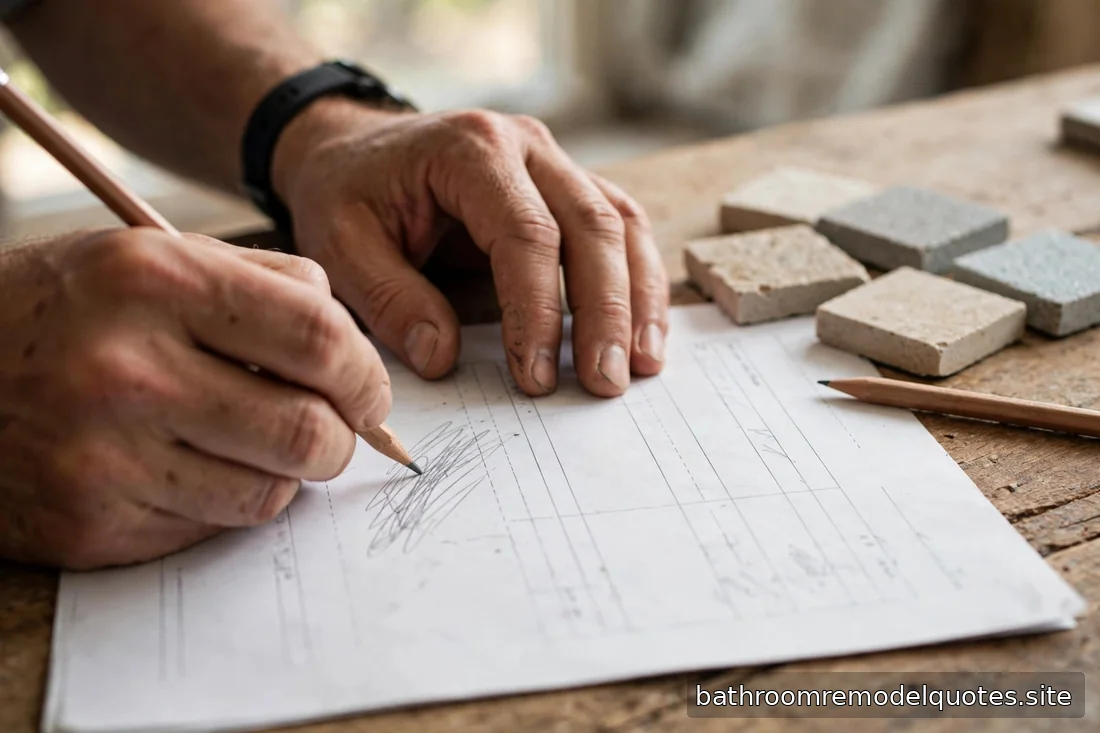
When three bids come back at $11,000, $14,500, and $18,000 for “the same job,” the $11,000 bid feels like a win. It’s usually a warning: bids that far apart differ in scope, materials, labor quality, or honesty.
The low bid is typically missing something: fantasy allowances (see #3), no demolition or haul-away, uncapped “as needed” plumbing, or a change-order markup plan. Angi’s own advice on saving money says to collect several quotes and go with the best deal — but adds that the lowest number isn’t always the best, and to factor in reviews. (Angi)
The fix is the scope-first method: give every bidder the same written scope and require itemized line items, then compare line by line. The cheapest-looking bid usually reveals its gaps on line 14. Check license and insurance before price — an unlicensed low bidder isn’t a bargain, they’re a liability.
8. No Written Payment Schedule
Money timing matters as much as money amount: a modest deposit (often 10–30%), progress payments tied to completed milestones, and a meaningful final payment — typically 10% or more — held until the punch list is done and inspection passes.
The mistakes: paying 50%+ upfront (you’ve lost all leverage), paying cash with no receipts (no paper trail), and releasing the final payment before the punch list is complete (good luck getting them back for touch-ups). Tie every payment to something verifiable — “rough-in passed,” “tile complete,” “final walkthrough signed off.” If a contractor demands most of the money before meaningful work is done, walk away.
9. DIY Overreach on Skilled Work
DIY can genuinely save money — Angi names painting, installing mirrors, and swapping fixtures as DIYable savings, but draws a hard line at electrical, plumbing, HVAC, and structural work. (Angi)
DIY overreach blows budgets two ways: a failed DIY plumbing or tile job that a pro must tear out and redo costs more than hiring the pro first; and unpermitted DIY electrical or plumbing that surfaces at sale time, forcing retroactive permits at the worst moment.
The honest self-test: if the work needs a permit, needs walls opened, or can flood your house if done wrong, it’s pro work. Paint the walls, install the mirror, swap the towel bars — pocket those savings and spend them where skill matters. (Our DIY vs pro guide draws the full boundary line.)
Two Cautionary Scenarios
Priya in Austin, Texas — the allowance trap. Priya accepted a $13,000 bid with $900 tile and $1,100 vanity allowances — before selecting anything. Her chosen finishes cost $1,700 and $1,900 installed, pushing the project to $14,600 before a single change order. The competing $14,200 bid with specified materials would have been cheaper. Lesson: allowances are guesses; fixed selections are prices.
Tom in Charlotte, North Carolina — the creeping scope. Mid-project, Tom verbally approved a recessed niche ($350), a moved outlet ($175), a frameless glass door ($800 over plan), and a heated floor ($1,100). His $10,000 refresh closed at $12,800 — 28% over, with no single decision to blame. Lesson: freeze the scope in writing and price every change first.
Both projects were recoverable. Both would have landed on budget with a contingency fund, fixed selections, and written change orders — mistakes #1, #3, and #4, avoided for the price of a few careful conversations.
Frequently Asked Questions
What’s the most common reason bathroom remodels go over budget?
Scope changes mid-project — moving fixtures, upgrading finishes, or adding features after demolition starts. Each change seems small, but change-order pricing is always worse than planned-work pricing, and the changes compound. A frozen written scope plus a 10–20% contingency fund prevents most overruns.
How much contingency should I budget for a bathroom remodel?
10–20% of the total budget, per Angi’s guidance — so $1,200–$2,400 on a $12,000 project. Bathrooms hide rotted subfloors, corroded drains, and outdated wiring that only appear after demolition. The contingency isn’t pessimism; it’s the documented reality of opening walls in a wet room.
Are allowances in a contractor bid a red flag?
Not automatically — they’re necessary when finishes aren’t selected yet. They become a trap when set unrealistically low to make the bid total look attractive. Convert every allowance to a fixed, specified selection before you sign, and compare bids on identical scopes.
Is it ever worth moving plumbing in a bathroom remodel?
Sometimes — a tub-to-shower conversion for accessibility or a layout that finally functions can be worth it. But go in with the real numbers: roughly $500–$1,000 to move a fixture a few feet, around $5,000 for a layout change requiring plumbing and electrical rework. Make it a conscious purchase, not a casual sketch.
Should I just hire the cheapest contractor?
No — bids that far apart are never for the same job. The low bid is usually missing scope, carrying fantasy allowances, or planning to make it up in change orders. Get itemized bids on an identical written scope, check license and insurance first, and remember Angi’s own advice: the lowest number isn’t always the best deal.
This is general information, not professional advice — get itemized bids for your project.