
Splurge on what’s behind the walls and under your feet; save on what you can see and swap later. That single rule — spend where failure is expensive, economize where replacement is easy — is the entire philosophy of a smart bathroom remodel budget.
A bathroom remodel runs $6,600–$17,600 nationally according to Angi, with basic refreshes far below that and high-end overhauls far above. (Angi) Where you land in that range has less to do with luck and more to do with a deliberate decision, made line by line, about which dollars do the heavy lifting.
Key takeaways
– Splurge on waterproofing, plumbing rough-in, the shower valve, tile installation labor, and ventilation — failures here cost 5–10x to fix later.
– Save on paint, mirrors, hardware, light fixtures, and the vanity cabinet — these are easy, cheap upgrades later.
– Keeping the existing layout is the single biggest money-saver; moving a toilet or drain can add thousands.
– A cosmetic refresh (paint, fixtures, hardware, re-caulk) can transform a bathroom for under $5,000.
– Never “save” by skipping the permit or the waterproofing membrane — that’s not saving, it’s borrowing trouble.
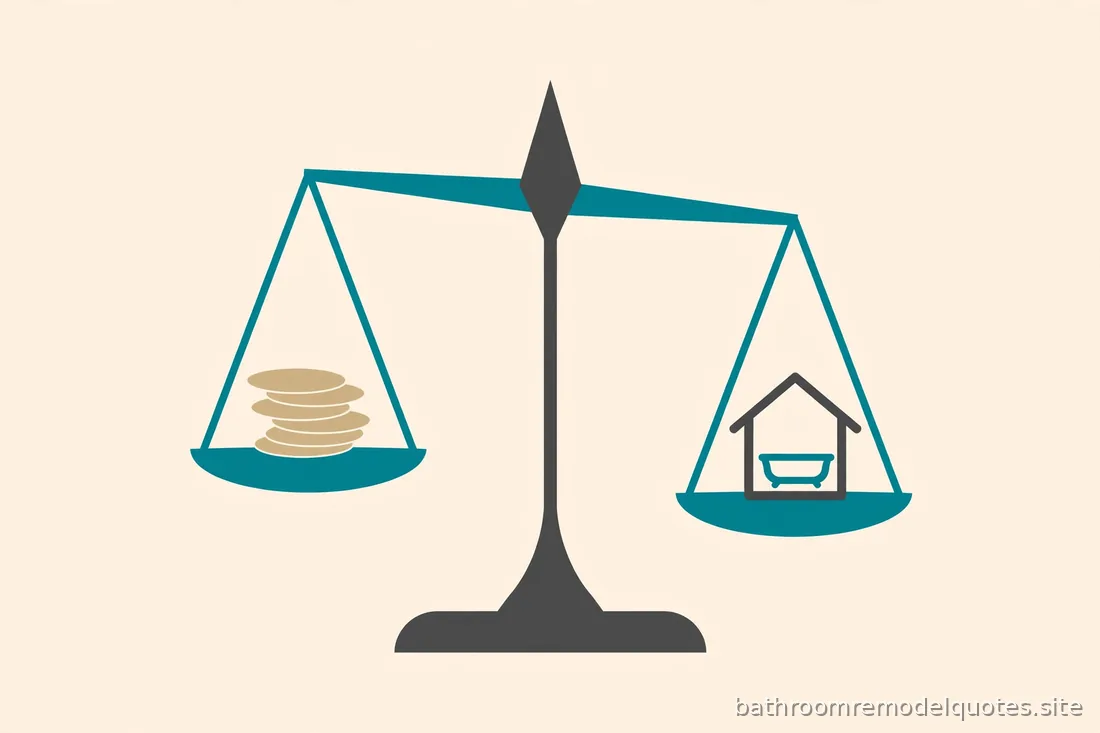
The One Rule Behind Every Decision
Ask of every line item: if this fails or disappoints, how expensive is the fix? A $40 faucet that drips in two years costs $40 and an afternoon to replace — cheap failure. A skipped waterproofing membrane that lets water into the wall cavity costs a second full remodel — catastrophic failure. Spend your money in inverse proportion to how easily something can be redone.
This Old House’s survey of 1,000 homeowners found that about 1 in 3 spent more than expected because of plumbing upgrades, water damage, or structural repairs — the hidden stuff, not the pretty stuff. (This Old House) The budget winners are the people who funded the hidden stuff first.
Splurge: The 5 Things Worth Real Money
1. Waterproofing and tile installation labor. The tile itself can be $2-a-square-foot ceramic; the installation is where the craft lives. A properly waterproofed shower — membrane, sealed seams, correctly sloped pan — is invisible when it works and catastrophic when it doesn’t. This Old House puts complete shower installation at a $8,044 national average precisely because the wet area is the most complex, most failure-prone part of the job. (This Old House) Pay for the best tile setter you can find, even if it means buying cheaper tile.
2. Plumbing rough-in and the shower valve. Moving supply lines is expensive; moving drains is roughly twice as expensive (Angi’s expert reviewer said exactly this). Get the layout right once. And spend the extra $100–$200 on a quality pressure-balancing or thermostatic shower valve from an established brand — the valve body lives inside your wall for decades, and replacing a cheap one means opening the wall.
3. Ventilation. A proper exhaust fan sized for the room, ducted to the outside (not into the attic), prevents the mold and peeling paint that ruin budget remodels within two years. It’s a few hundred dollars installed. Skip it and you’ll repaint every other year.
4. The toilet (mid-range, not luxury). You don’t need a $1,200 smart toilet. But the $89 special with a weak flush will annoy you daily for a decade. The mid-range $250–$400 models from established brands flush reliably and have readily available parts. Toilets average $467 installed nationally. (This Old House)
5. Labor for anything involving water or electricity. Angi puts bathroom labor at $50–$110 per hour, and 40–65% of a full remodel goes to labor. (Angi; Boss Design Center) This is not the place to hire the cheapest bidder. A bad grout job can be redone; a bad plumbing job floods the kitchen below.
Save: The 7 Things to Buy Cheap (Smartly)
1. Paint. A gallon of quality bathroom paint is $40–$60 and a weekend. This is the highest-ROI dollar in remodeling — Angi credits interior paint with a 107% ROI. (Angi)
2. Mirrors. A $60 big-box mirror reflects exactly as well as a $400 designer one. Upgrade later in an afternoon whenever you want.
3. Hardware and accessories. Towel bars, hooks, toilet-paper holders, cabinet pulls — buy the finish you like at the price you like. They’re screws, not commitments.
4. Light fixtures (surface-mount). Swapping a vanity light bar is a 30-minute job. Buy the $80 fixture now; the $300 one can wait five years. (Moving or adding lights needs an electrician — that’s the splurge side. Swapping in place is the save side.)
5. The vanity cabinet. A stock 36-inch vanity runs $300–$1,200, and in a secondary bath nobody will know or care. Put the vanity money into the countertop and faucet instead — that’s what hands touch. (Our vanity cost breakdown compares stock vs semi-custom vs custom pricing.)
6. The faucet (within reason). A mid-range faucet from a major brand ($100–$200) gives you 90% of the $500 designer faucet’s function and finish. Avoid the no-name $35 special — replacement parts won’t exist in three years.
7. Flooring material (not installation). Luxury vinyl plank or tile-look vinyl can mimic stone convincingly at a fraction of the cost, and in a bathroom it’s arguably more practical. Save on the material; don’t skimp on the installer.
The Save-vs-Splurge Matrix
| Item | Verdict | Why |
|---|---|---|
| Waterproofing system | SPLURGE | Failure = second remodel |
| Tile installation labor | SPLURGE | Craft is invisible until it fails |
| Plumbing rough-in / layout | SPLURGE | Moving drains costs thousands |
| Shower valve body | SPLURGE | Lives in the wall for decades |
| Exhaust fan + ducting | SPLURGE | Prevents mold, protects everything else |
| Licensed electrician/plumber | SPLURGE | Safety + code + insurance validity |
| Paint | SAVE | $50 and a weekend, 107% ROI |
| Mirror | SAVE | Swappable in minutes |
| Hardware / accessories | SAVE | Screws, not commitments |
| Light fixtures (swap-in-place) | SAVE | 30-minute upgrade path |
| Stock vanity cabinet | SAVE | Nobody touches the cabinet box |
| Mid-range faucet, major brand | SAVE | 90% of designer function |
| Vinyl/LVP flooring material | SAVE | Practical and convincing |
| Moving the toilet “a few inches” | NEITHER — DON’T | Thousands for no visible gain |
The $5,000 Cosmetic Refresh Path
Not every bathroom needs a gut. If the layout works, the plumbing is sound, and the tub is solid, a cosmetic refresh delivers shocking transformation per dollar:
- Paint walls and ceiling (mold-resistant bathroom paint): ~$150
- Re-caulk tub, shower, and toilet base: ~$30
- New mirror, light fixture, hardware: ~$300–$500
- New faucet: ~$150
- Re-glaze or refinish the tub instead of replacing: far cheaper than a new tub install, and Angi specifically lists tub refinishing as a money-saver (Angi)
- New toilet seat, showerhead, accessories: ~$150
- Deep clean and re-grout: ~$50 in materials or a few hundred hired out
Total: roughly $1,000–$2,500 DIY, $3,000–$5,000 hired out — and it reads as a “new bathroom” to everyone who walks in. This Old House’s designer source gives the same advice: refinish existing fixtures, update cabinet doors rather than replacing cabinets, and keep the original layout. (This Old House)
Three Budget Scenarios, Named and Priced
Priya’s refresh — ~$4,500. Priya’s 1990s hall bath works fine but looks tired. She keeps everything where it is: new paint, new mirror and light bar, new faucet and showerhead, re-caulked tub, new hardware, and a hired handyman for the fixture swaps. Two weekends of her own labor. The bathroom looks a decade newer. Nothing behind the walls was touched — because nothing needed to be.
Marcus’s mid-range gut — ~$14,000. Marcus’s master bath has a leaking shower pan — the one thing you can’t refresh around. Same layout (this is the key decision that keeps it at $14k instead of $20k): new waterproofed tile shower, stock vanity with quartz-look top, LVP flooring, mid-range toilet and faucet, new exhaust fan properly ducted. He splurges on the tile setter and the plumber, saves on the vanity and mirror. This lands squarely in This Old House’s midrange band of $14,609–$19,040 for a 50-square-foot bath. (This Old House)
Dana and Luis’s primary-suite splurge — ~$28,000. They move the shower to gain space (drain relocation: the expensive part), install a curbless tile shower with a frameless glass enclosure, a 60-inch semi-custom double vanity, heated floors, and a quiet high-CFM fan. They still save where it doesn’t matter — stock mirror, mid-range faucets — because the splurges are all in the wet area and the layout. High-end 50-square-foot remodels run $27,492–$35,808 nationally. (This Old House)
Budget Traps That Aren’t Savings
- Skipping the permit to “save” $200–$500. Unpermitted plumbing and electrical can void your homeowner’s insurance and torpedo a future sale. The permit is the cheapest insurance on the job.
- The cheapest tile setter. Bad tile work fails within years, and re-tiling means re-waterproofing — you pay for the shower twice.
- Allowances you didn’t scrutinize. A “$400 tile allowance” that covers only builder-grade ceramic while you picked $12/sq-ft handmade tile is a $2,000 surprise, not a saving.
- One-day bath overlays as a “remodel.” Acrylic tub and shower liners glued over the old unit cost thousands and hide whatever’s behind the old walls. Sometimes fine as a stopgap; never confuse it with a remodel. Our one-day bath truth guide breaks down what those ads don’t say.
- Buying everything at the cheapest online price with no lead-time check. The $200 you saved on the vanity evaporates when the contractor’s crew stands idle for three weeks waiting for it.
For the full national picture behind these numbers, see our bathroom remodel cost guide and the 2026 cost update for what’s moved this year.
Frequently Asked Questions
What’s the cheapest way to remodel a bathroom?
Keep the layout exactly as-is and do a cosmetic refresh: paint, hardware, mirror, light fixture, faucet, showerhead, re-caulk, and tub refinishing if needed. DIY portions run $1,000–$2,500; hiring out the fixture swaps lands around $3,000–$5,000. The moment you move plumbing or gut to the studs, you’re in five-figure territory.
Where should I never cut corners in a bathroom remodel?
Waterproofing, plumbing, electrical, and ventilation — the systems inside the walls and ceiling. Failures here damage the rest of the house and cost multiples of the original job to fix. Cut corners on finishes instead; they’re replaceable.
Is it cheaper to remodel the bathroom myself?
Partially. Painting, hardware swaps, mirror installation, and even LVP flooring are realistic DIY savings — Angi specifically lists painting, mirrors, and fixture swaps as DIYable. Plumbing, electrical, and tile-setting in wet areas are where DIY mistakes get expensive.
How much should I set aside for surprises?
10–20% of the project budget, per Angi’s standard guidance. On a $15,000 remodel, that’s $1,500–$3,000 sitting untouched until the walls are open and the inspections are passed. Given that a third of homeowners hit plumbing, water-damage, or structural surprises, this isn’t pessimism — it’s arithmetic.
Does a budget bathroom remodel hurt resale value?
A clean, functional, neutral bathroom helps resale at any budget; a visibly cheap one with failing grout and a wobbly toilet hurts it. Appraisers and buyers respond to condition and function far more than to how much you spent. Mid-range remodels historically recoup around 70–80% at resale, while ultra-cheap flip-grade work can actually raise buyer suspicion.
This is general information, not professional advice — get itemized bids for your project.